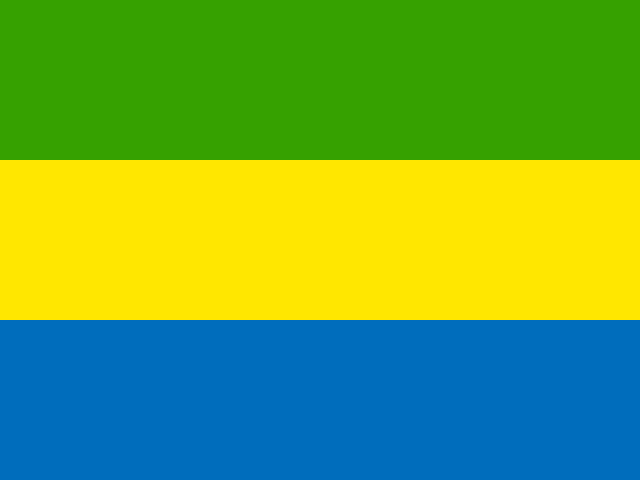
Gabon map quiz
Explore the cities of Gabon!
Quizzes in this pack
Gabon: cities, landmarks.
| Cities | 8 questions |
| Landmarks | 8 questions |
Sample questions
- Capital city on the Komo estuary, founded in 1849 by freed slaves, its name means 'Free Town' in French, a modern oil-wealthy city with the Presidential Palace and waterfront boulevard
- Answer: Libreville
- Second-largest city and economic capital on Mandji Island, Gabon's oil industry hub accessible only by air or sea, with refineries, an Atlantic beach, and the nearby Loango National Park
- Answer: Port-Gentil
- Inland city in the southeast founded by French explorer Pierre Savorgnan de Brazza, near the Oklo natural nuclear reactor site and manganese mining operations, birthplace of Omar Bongo
- Answer: Franceville
- Northern city and capital of the Woleu-Ntem province near the borders with Cameroon and Equatorial Guinea, a cocoa trading centre surrounded by dense equatorial forest
- Answer: Oyem
- River town on the Ogooué River, famous as the site of Albert Schweitzer's hospital founded in 1913, now a museum, surrounded by lake islands and the gateway to equatorial rainforest
- Answer: Lambaréné
Learn more
Libreville
Estuary of the Komo, Gabon
Libreville means “free town”. It was founded in 1849 by people freed from a slave ship that the French navy had stopped. Today it is the capital of Gabon, by the mouth of the river Komo.
- Founded
- 1849
- Libreville lies just north of the equator
Franceville
South-eastern Gabon
Franceville was founded in 1880 by the explorer Pierre Savorgnan de Brazza as a village for freed slaves, in the hills of south-eastern Gabon. Manganese and uranium have been mined nearby, and the town has the country's science university.
- Known for
- De Brazza, manganese, the university
Mouila
Ngounié, southern Gabon
Mouila is the capital of the Ngounié province in southern Gabon, on the Ngounié River. Its best-known sight is Lac Bleu, a small lake with strikingly blue water. In the villages around the town people follow Bwiti, an old spiritual tradition of the forest, and new members dance in public when their training is over.
- Known for
- Lac Bleu, the Ngounié River, Bwiti
Lopé National Park
Ogooué-Ivindo Province
Lopé National Park in central Gabon mixes rainforest with patches of savanna left from drier times after the ice age. Gorillas, forest elephants and mandrills live here, and rock carvings show that people lived here thousands of years ago.
- Did you know?
- Groups of hundreds of mandrills, the largest monkeys, have been seen here
Ivindo National Park
Ogooué-Ivindo Province
Ivindo National Park in north-eastern Gabon protects untouched rainforest along the Ivindo River, where it tumbles over a series of waterfalls, among them Kongou Falls. The park is also known for Langoué Bai, a forest clearing where elephants and gorillas come to feed on minerals.
- Opened
- National park in 2002
Pongara National Park
Across the estuary from Libreville
Pongara National Park lies across the Komo estuary from Libreville, with mangroves, forest and beaches. Leatherback turtles, the largest turtles in the world, come ashore here to lay eggs, and forest elephants walk on the beaches.
- Did you know?
- Gabon has made about a tenth of its land into national parks
How it works
Pick a quiz, then find, name or choose your answer on the 3D globe. A round has 10 questions by default, or more, up to the whole quiz. Each round picks what you need most: questions due again, new ones and the places you tend to mix up. In a short round, the questions you miss are asked once more at the end. Spaced repetition then brings them back on later days until you know them.
Every round also fills your mastery badges for the continent or country, the topic and the whole world: bronze at 50%, silver at 80% and gold at 100%.