
About Fathom
Explore the world. Remember what you learn.
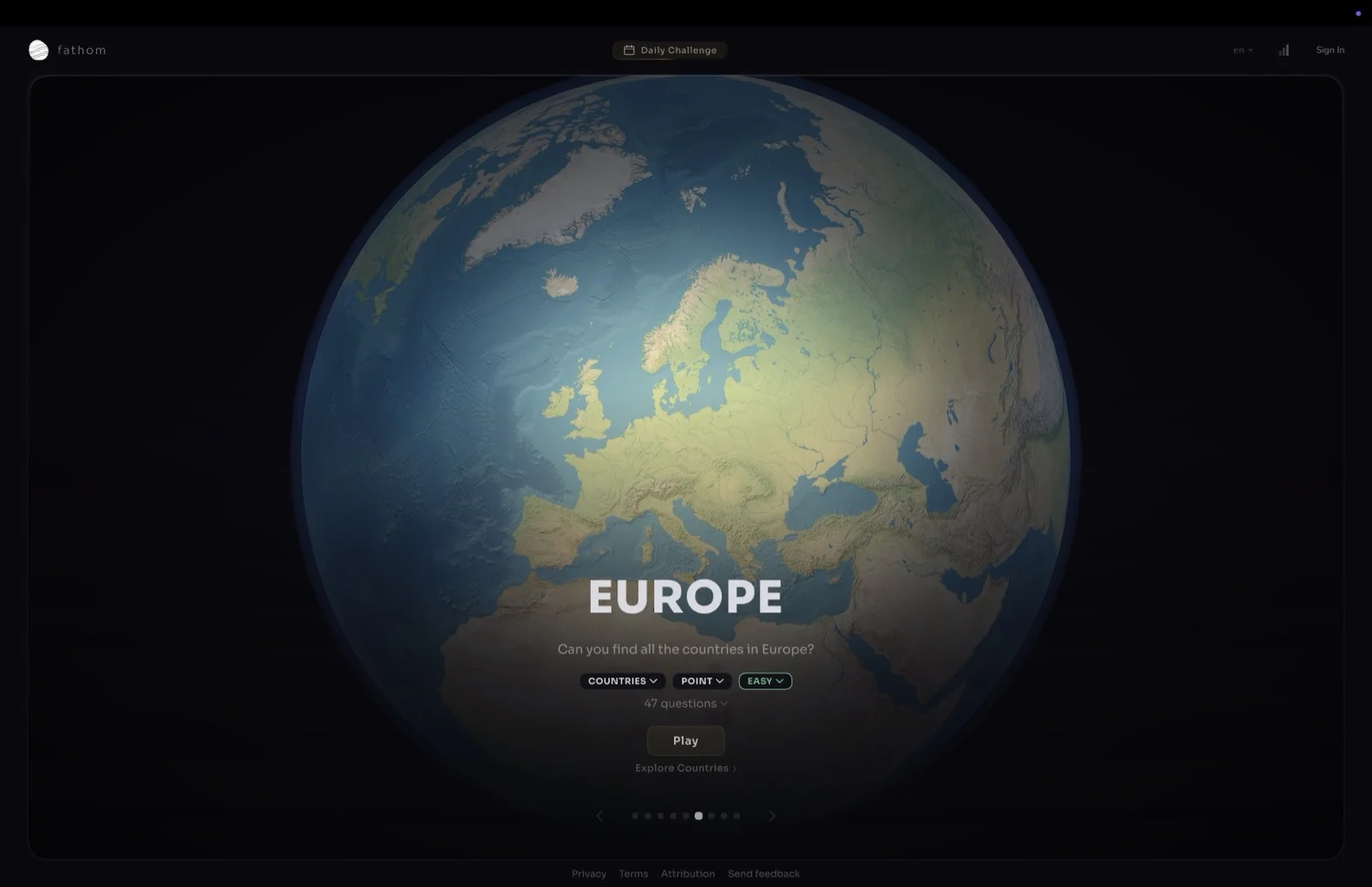
Fathom is a free geography learning game built around an interactive 3D globe. Learn countries, capitals, flags, cities, landmarks, mountains, rivers and oceans by finding and naming them on the Earth itself.
Instead of only testing what you already know, Fathom helps you learn as you play. Discover the places behind the answers, get another go at what you missed, and watch your knowledge grow across the world.
There's no paywall, and you don't need an account to start.
Learn from mistakes, not just scores
Getting something wrong is part of learning.
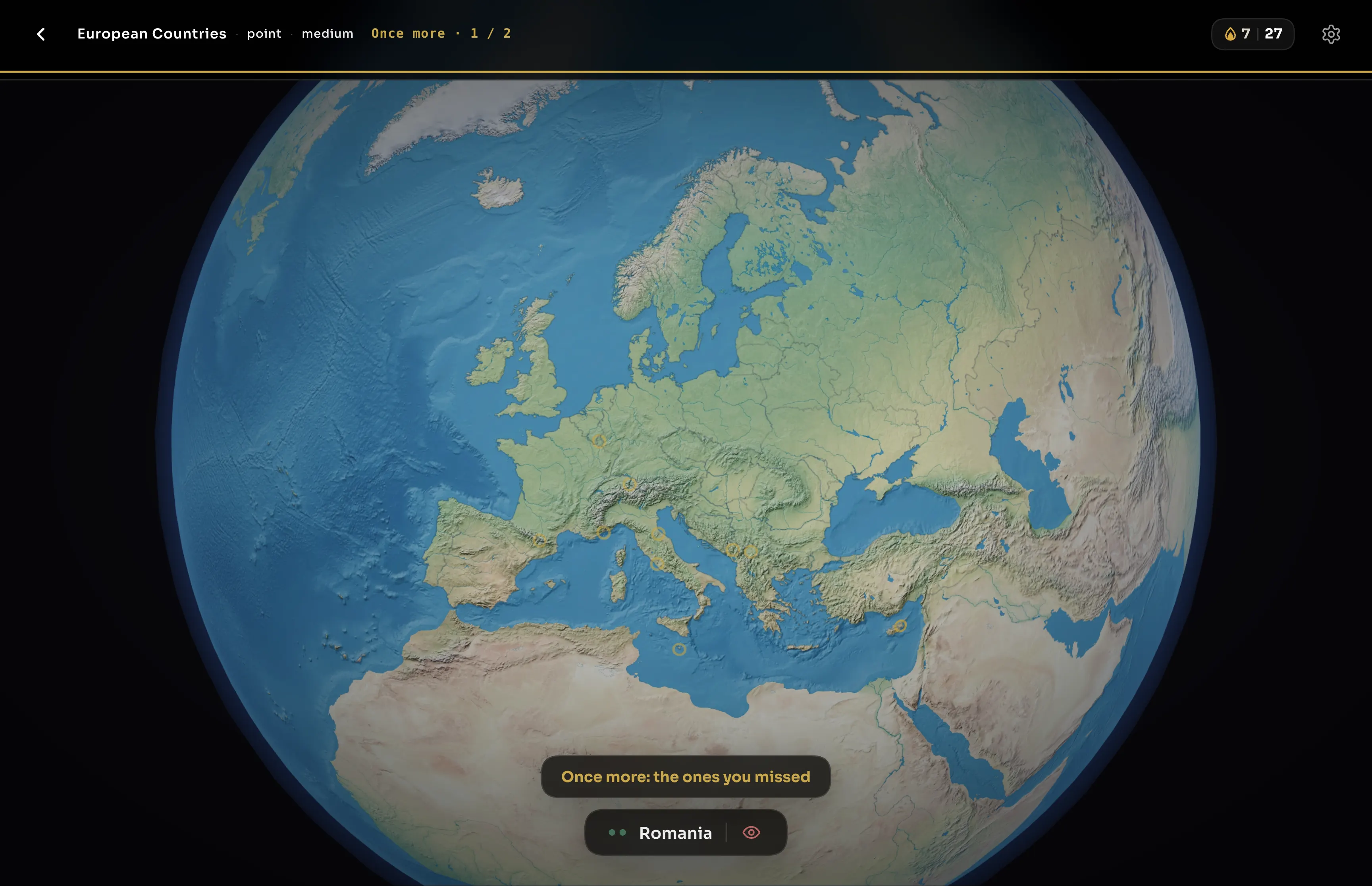
In a short round, the questions you miss are asked once more at the end, while they are still fresh in your mind. You get another try before you move on, not just a score.
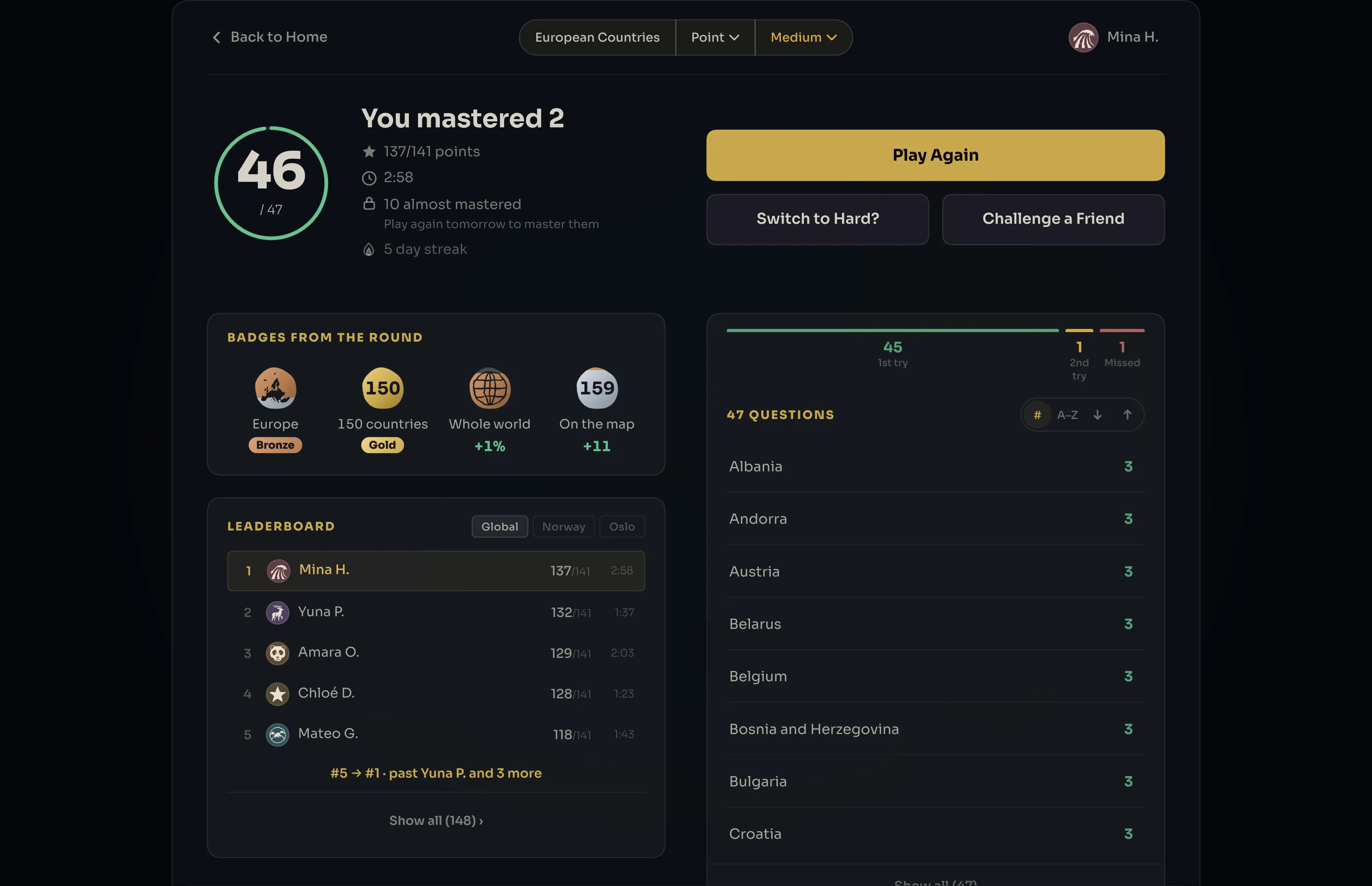
Learning continues between rounds. Fathom uses a four-box Leitner system for spaced repetition. Questions you struggle with come back sooner, and the ones you know come back after longer intervals, across days and weeks. Each round picks what you need most: questions due again, new ones, and the places you tend to mix up.
When your knowledge starts to fade, use Practise weak on the results screen or Practise now in the menu. Both gather what is due into one short session, so you don't have to replay a whole quiz.
Every question also has its own hand-written hint, such as a neighbouring country or a piece of history, to help you work towards the answer rather than guess.
The goal isn't to get every answer right the first time. It's to know more when you come back.
Go beyond the answer
Every place has a story.
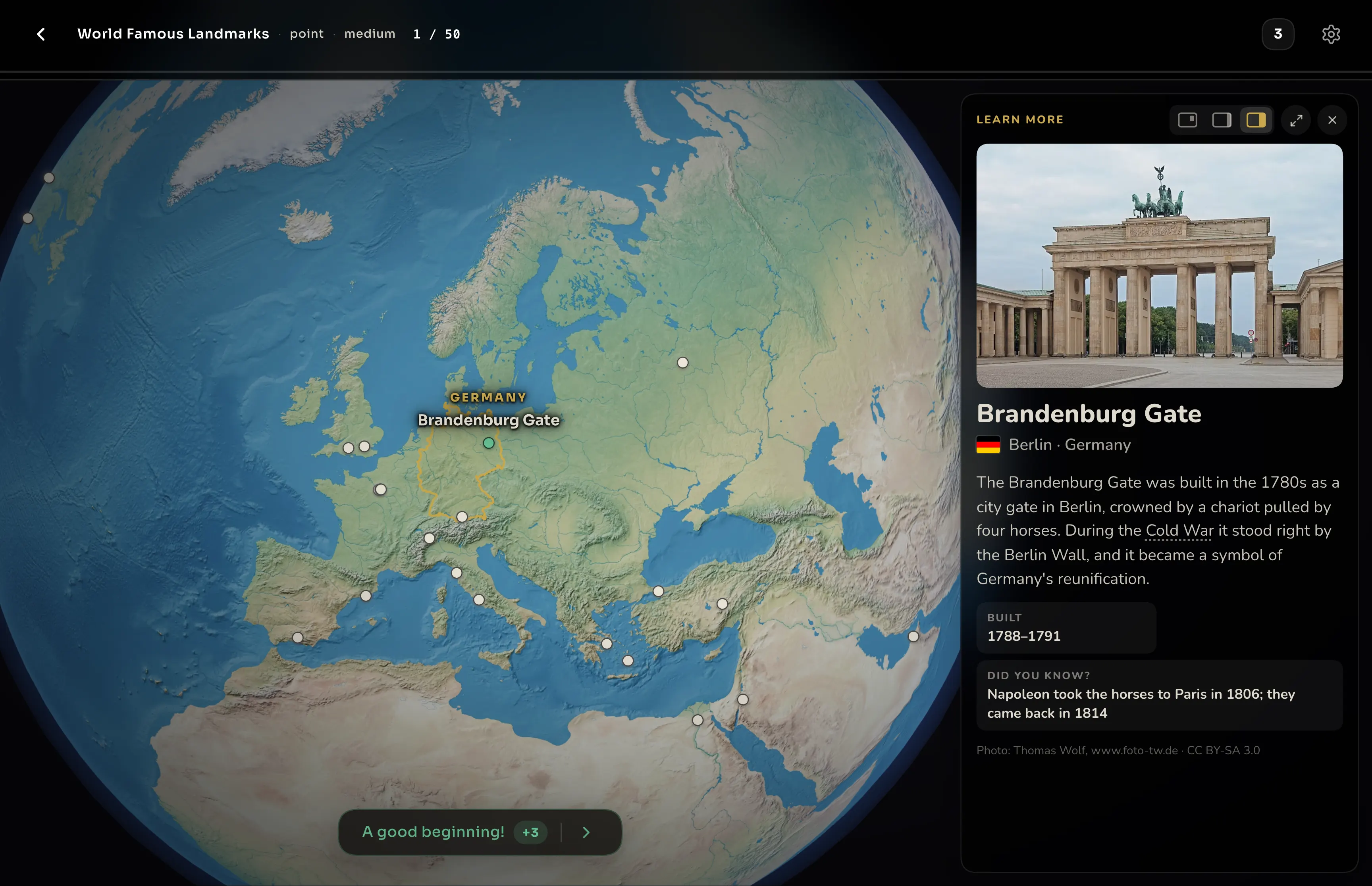
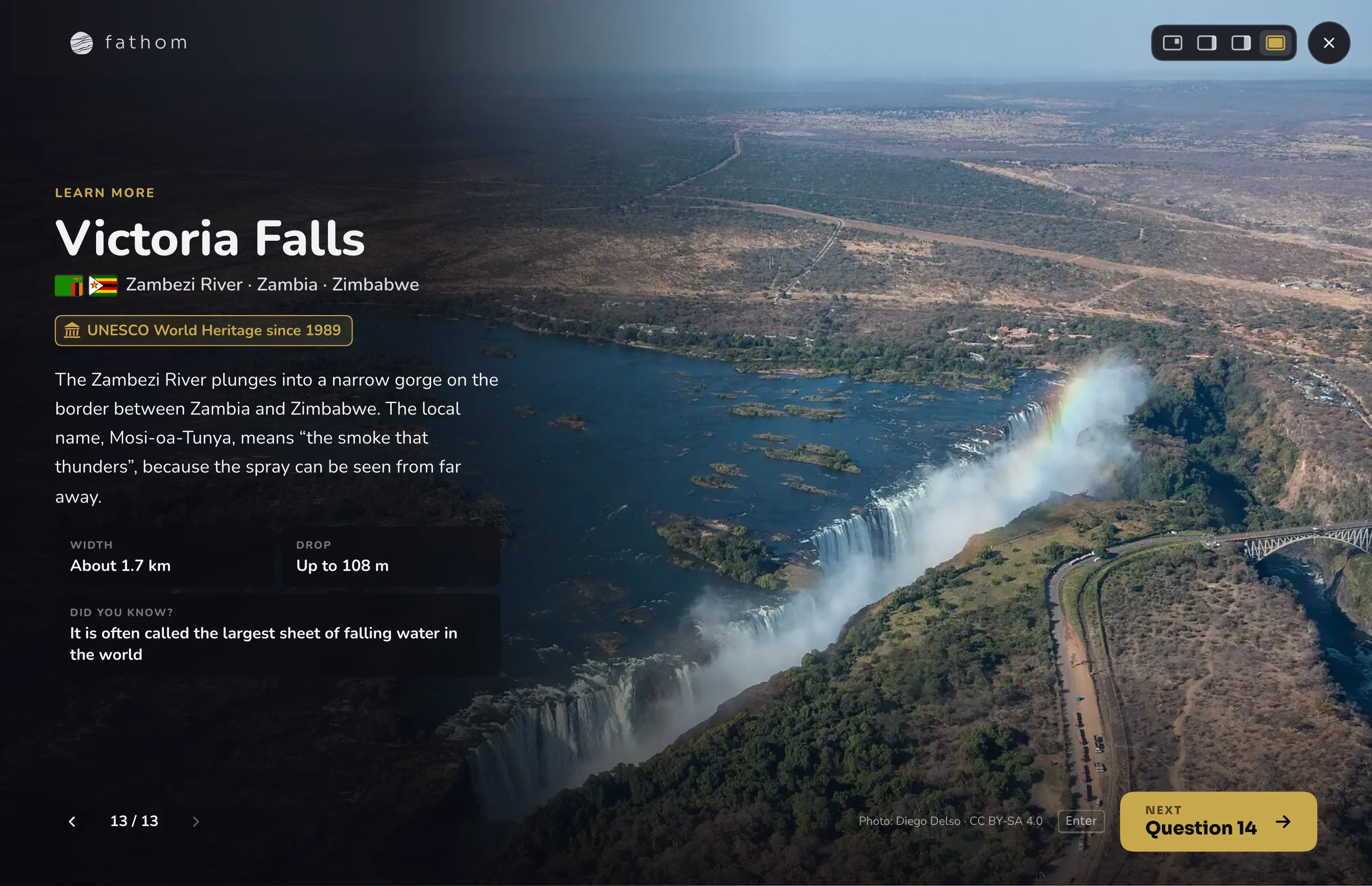
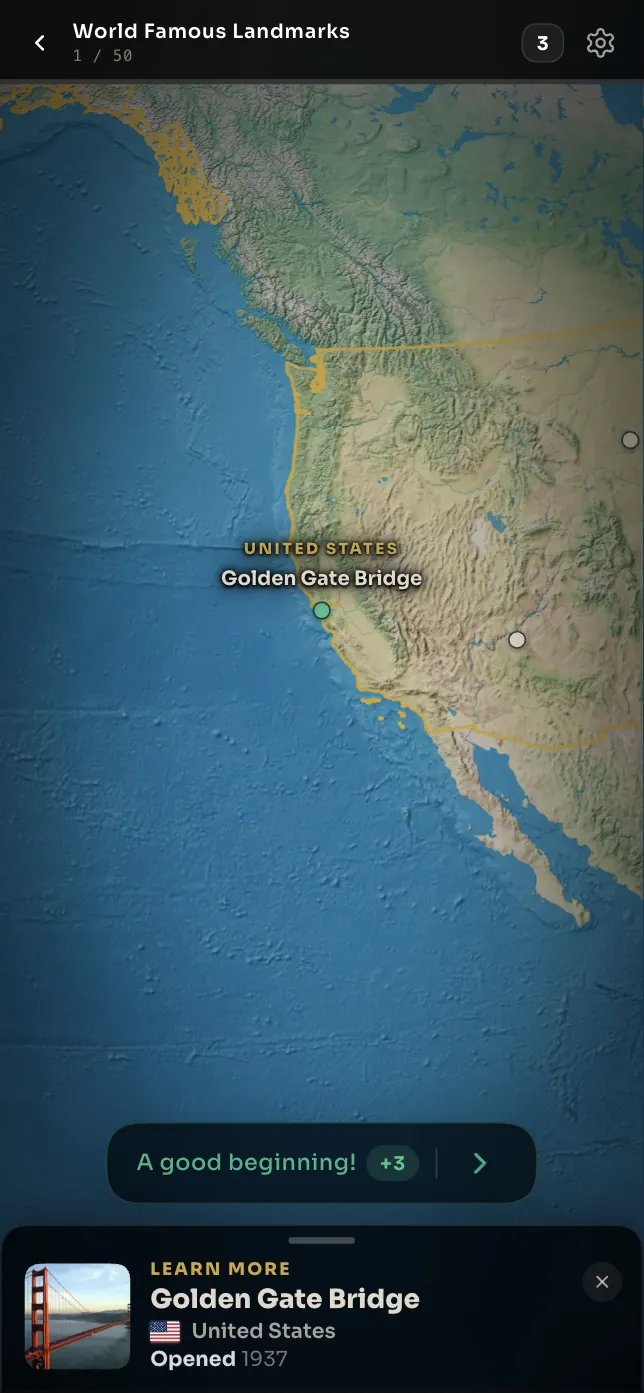
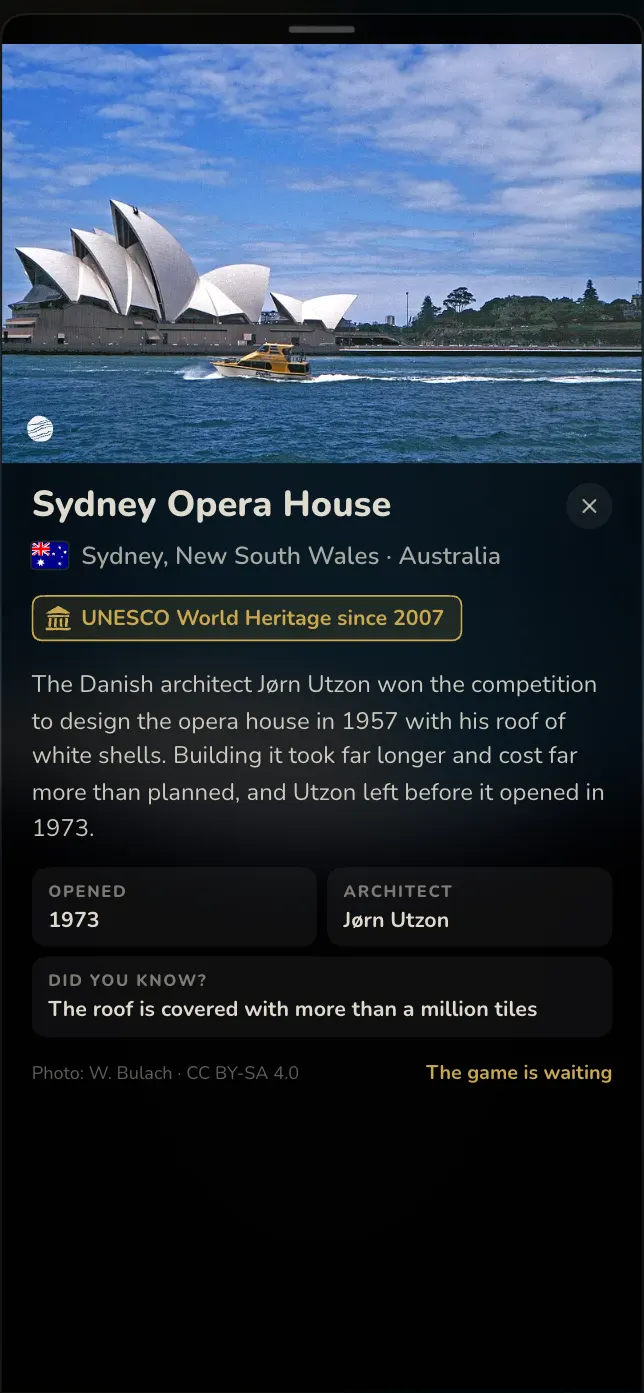
After you answer, Learn more shows a photograph and a few lines about the place: what it is, why it matters, and a fact or two. Where the place has them, these include its height, when it was built, or the year it became a UNESCO World Heritage Site.
Find out why Victoria Falls is called "the smoke that thunders", how Neuschwanstein came to be built, or what surrounds Machu Picchu high in the Andes.
Read it beside the globe, or open it full screen for a closer look. Read as much as you like, then go on to the next question when you're ready.
Every quiz has Learn more: all 6,767 questions have a photo and a few sentences about the place, 4,329 different places in all. For now the texts are in English, German, Spanish, French, Norwegian, and Polish; more languages are on the way.
Why Fathom?
To fathom something is to understand it deeply. A fathom is also a sailors' unit of depth, about 1.8 metres (six feet), once measured with a weighted line lowered into the sea.
Both meanings are part of the game.
The stone in Fathom's logo is that weight. Every step a question climbs in spaced repetition takes the stone deeper. The bottom of the ocean, the Challenger Deep at 10,935 metres, stands for everything there is to learn. Your depth follows what you have learned, not how many rounds you have played. Forgetting never pulls the stone back up.
After a round in which you make progress, the stone sinks further through the ocean's real zones: the sunlit surface, the twilight and midnight zones, the abyss and the trenches. On the way you pass 28 finds at their real height or depth, from the Great Pyramid and an emperor penguin's dive to a sperm whale's dive and the deepest fish ever filmed. Each find and each new zone earns a badge of its own.
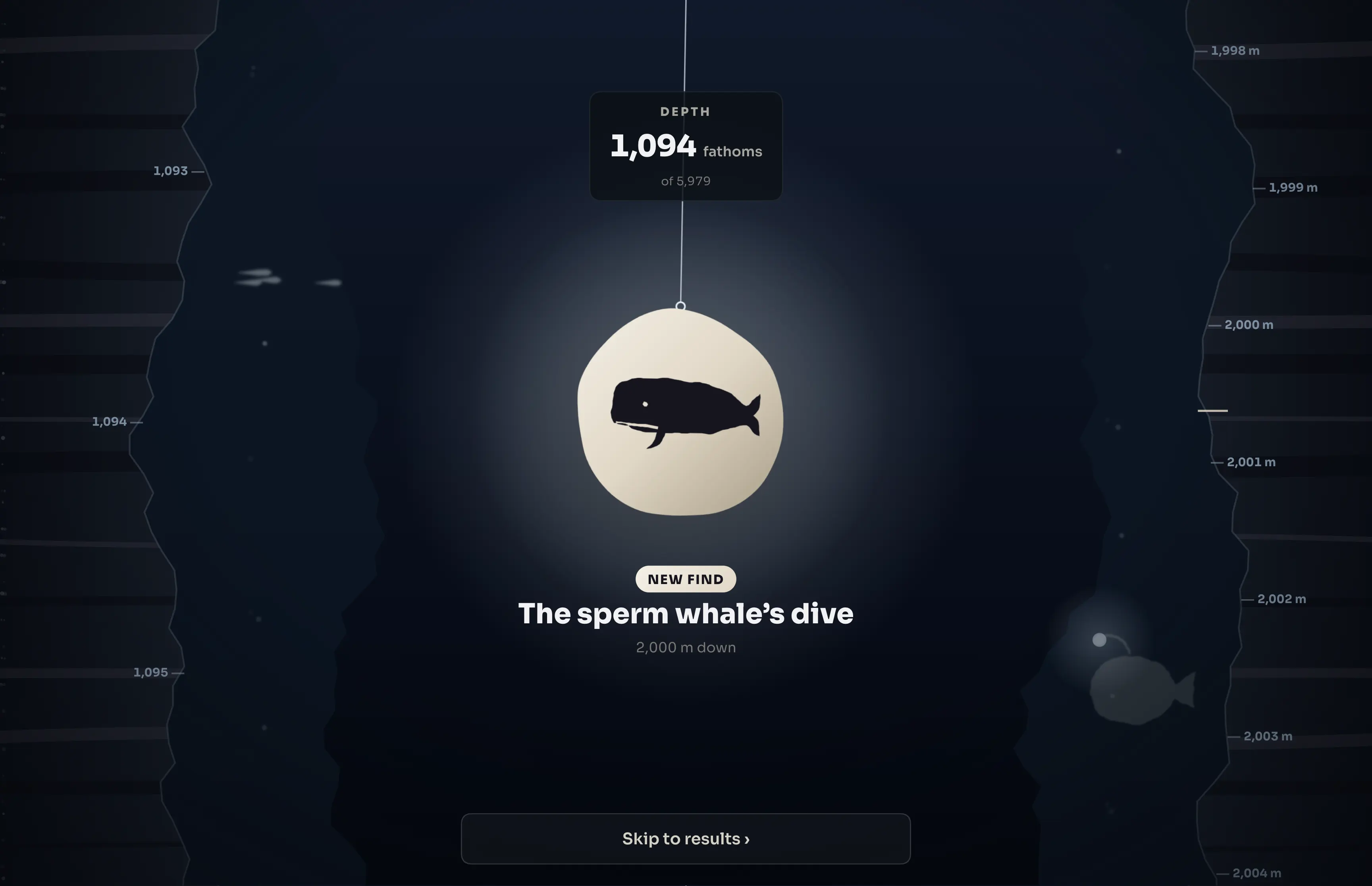
The sea life around the stone changes with depth: humpback whales and dolphins near the surface, and anglerfish lighting the dark. The wrecks of the Titanic and the Bismarck are finds too: once you have passed them, they lie at their real depth.
The more you learn, the deeper you go.
Explore a living globe, your way
Spin a detailed Earth with mountains, coastlines and slowly drifting clouds. Choose Day, Night or Real sun, which shows day and night where they are right now.
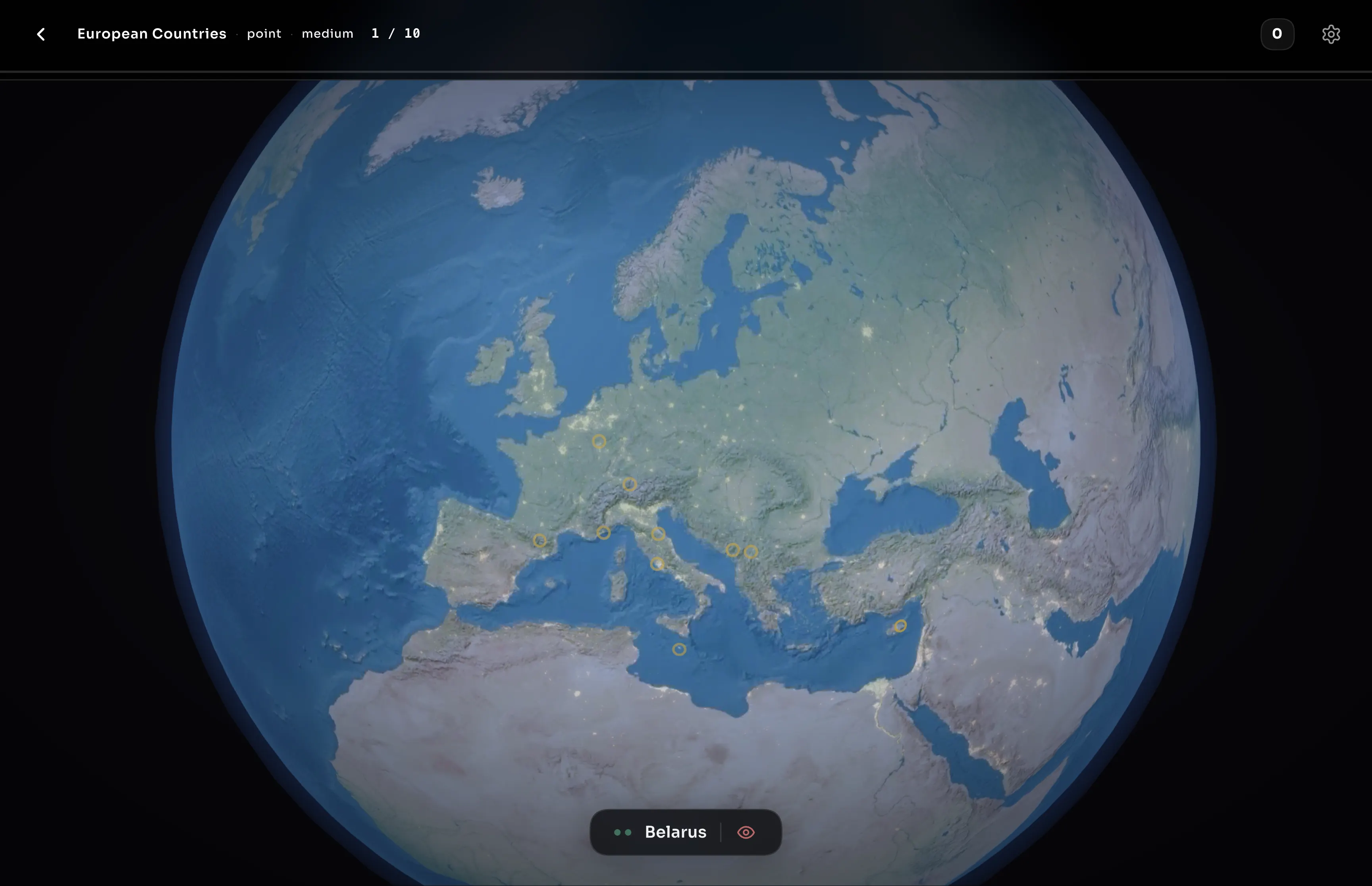
Answer the way you like: find places on the globe, pick from multiple choices, type the name, estimate where something is, or compare two countries by population or area. Choose easy, medium or hard.
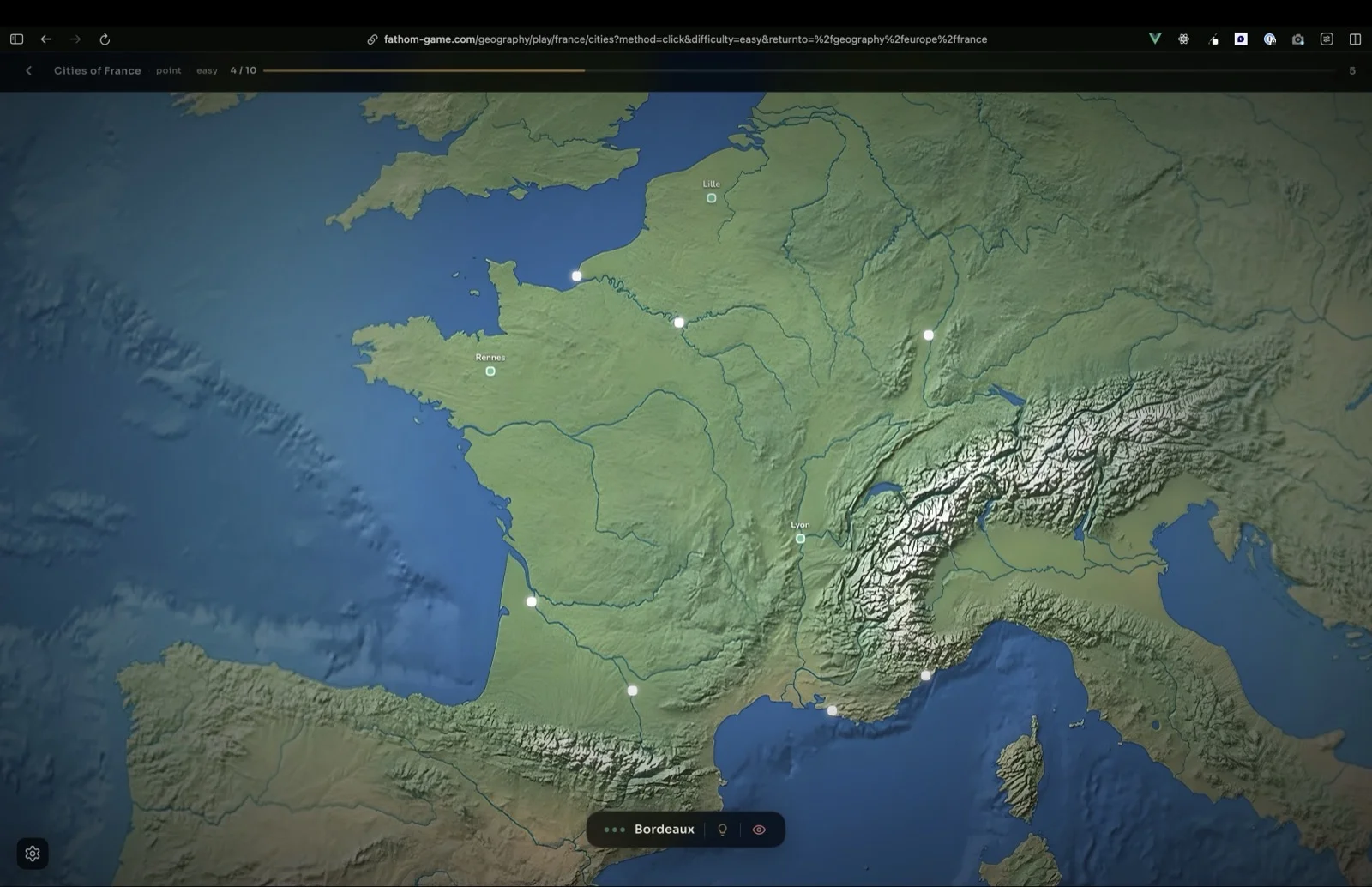
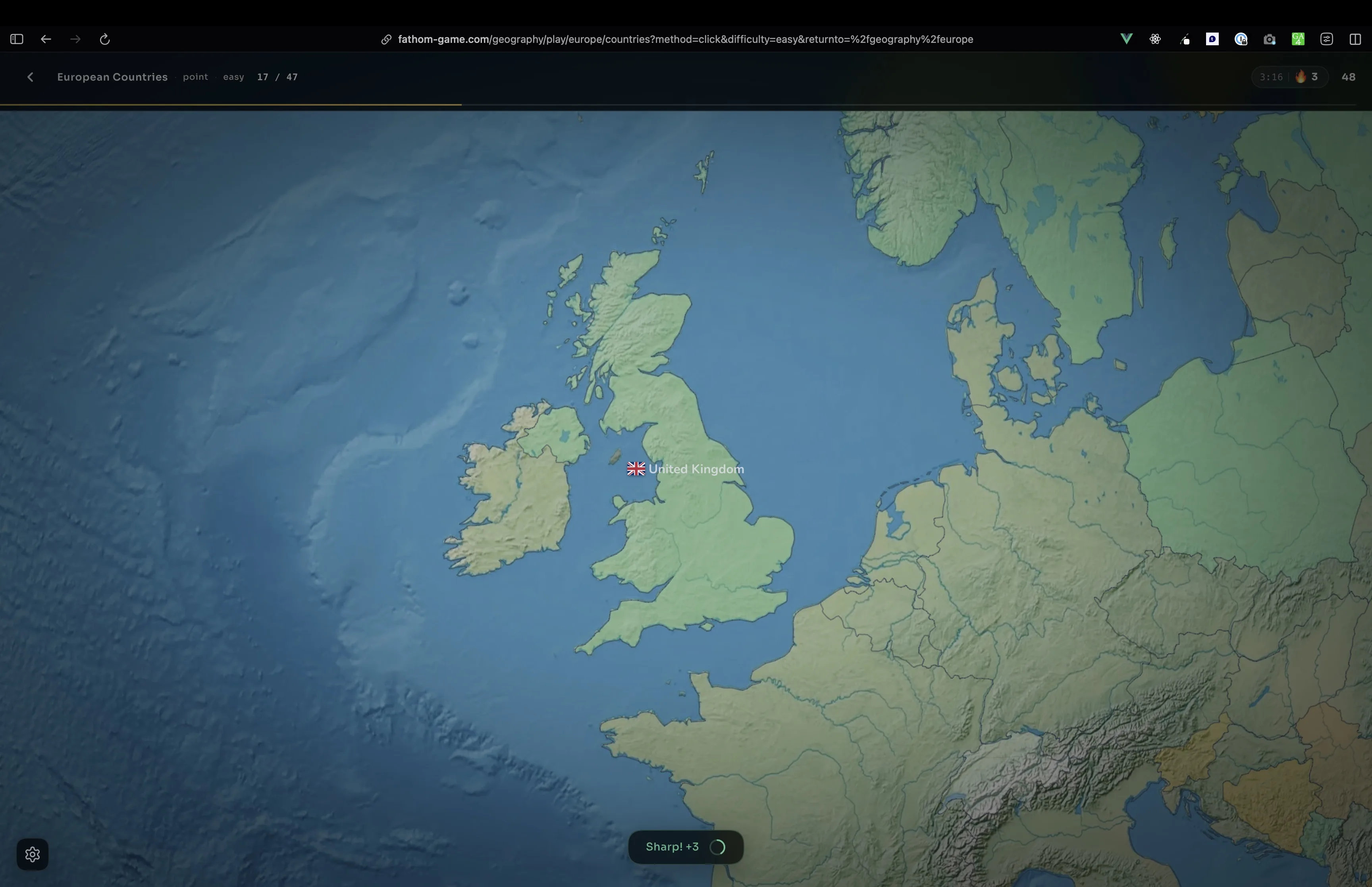
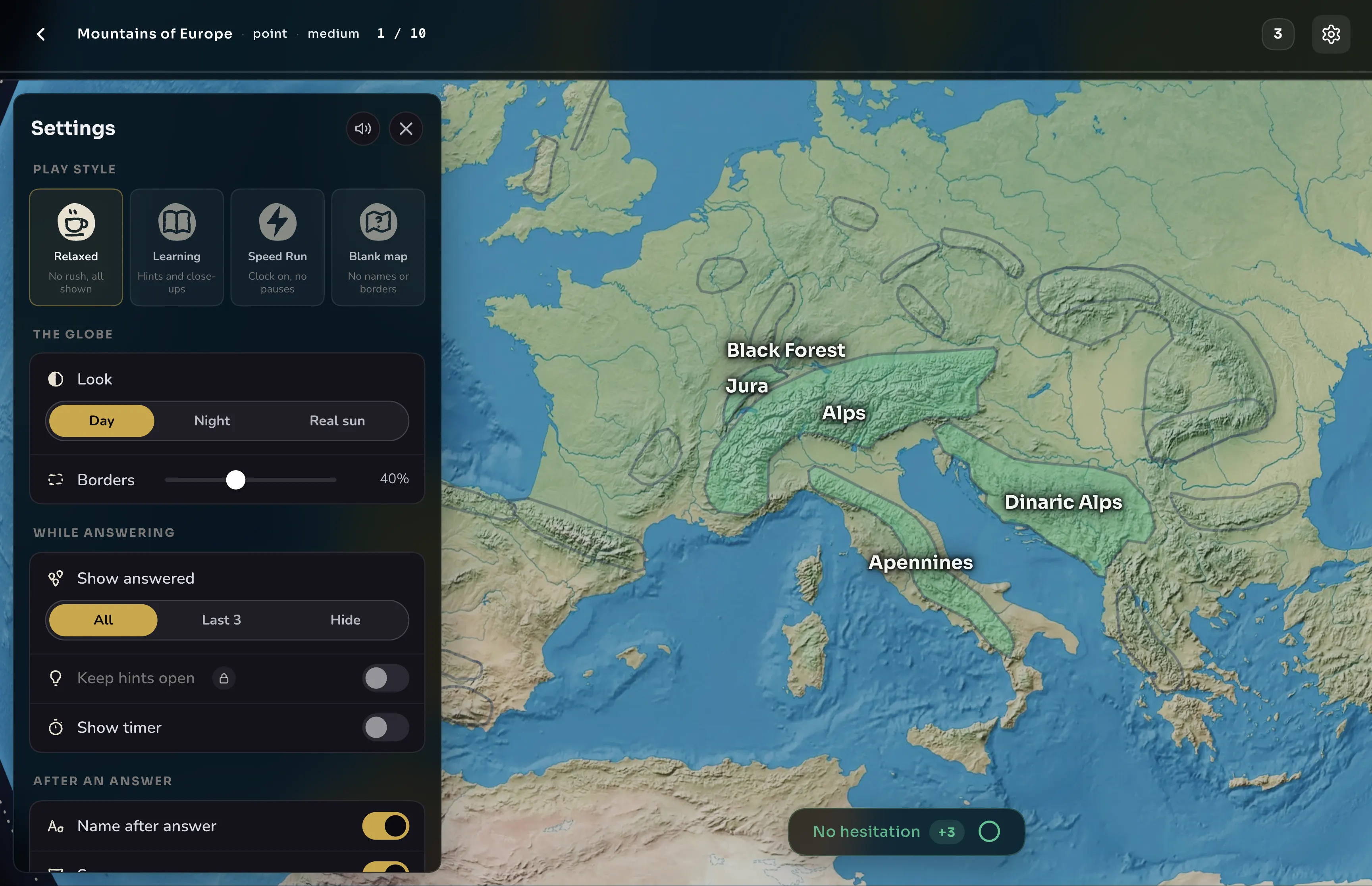
Choose a play style: Relaxed, Learning, Speed Run or Blank map, which has no names or borders. Or adjust the camera, borders, hints, timer and sound yourself, and see each change on the quiz in front of you. Ambient sound is off at first; turn it on to hear it change from the quiet of space to the clouds and the land below.
A round has 10 questions by default. You can choose a longer round or play the whole quiz. Your progress is saved after every answer, so you can stop and pick up where you left off.
Every region has a Mixed quiz that brings together questions from all its quizzes, covering countries, capitals, flags, cities, mountains, rivers and more. Start with 10 questions, try a longer round, or test yourself on everything. World has 1,106 questions to explore. Every answer counts towards your progress in its original quiz, so you can find out what you know and what you still need to learn.
Progress without pressure
Every continent, World quiz and country you play has a badge: a hand-drawn stone that fills with metal as your mastery grows. Bronze means 50% mastery, silver 80% and gold 100%. After each round you see which badges have moved up. A badge keeps the highest level it has reached. If some of what you learned starts to fade, the stone cracks, and Repair brings back the questions that have faded.
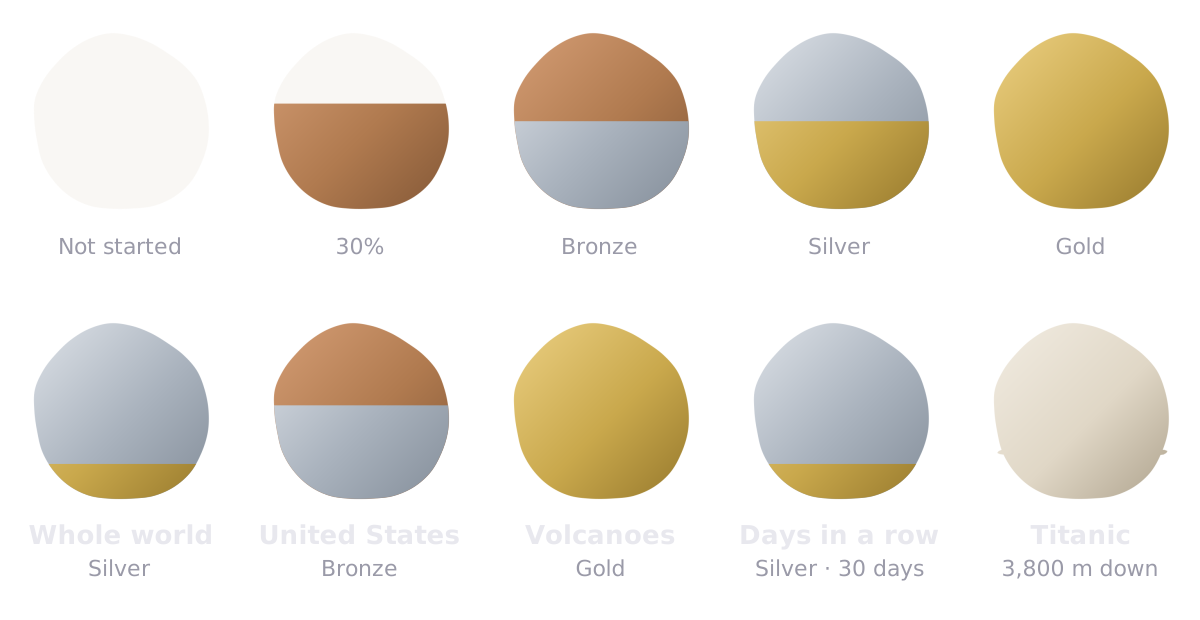
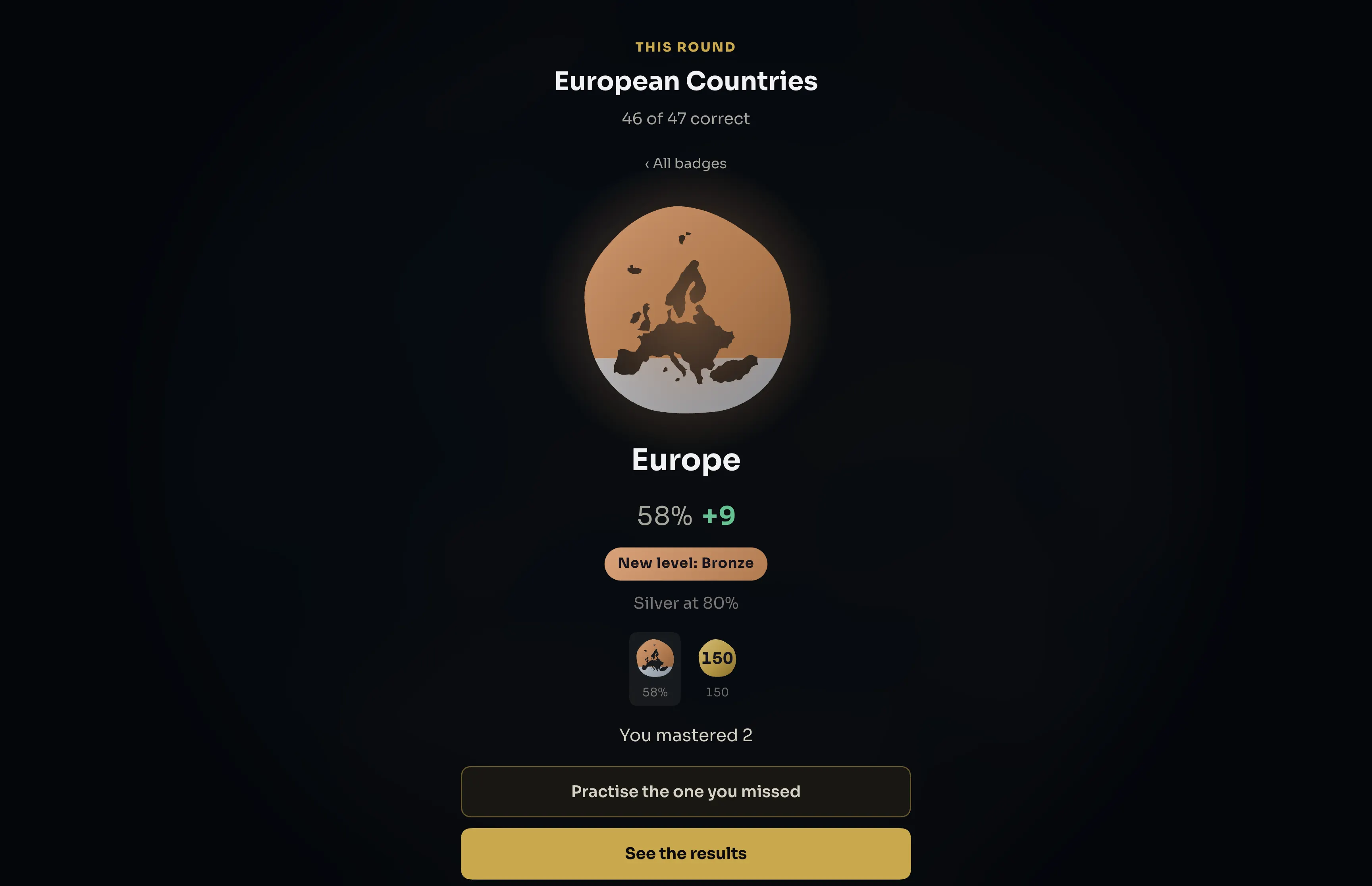
Your dive has badges too: one for every find you pass and every ocean zone you reach. These badges stay yours, however long you have been away.
You also earn shards: for questions you master, days you play, rounds you finish, daily challenges, new badge tiers and milestones in days in a row. Use shards to buy freezes. You can hold 3, and one is used automatically on a day you miss, so a busy day doesn't break your days in a row.
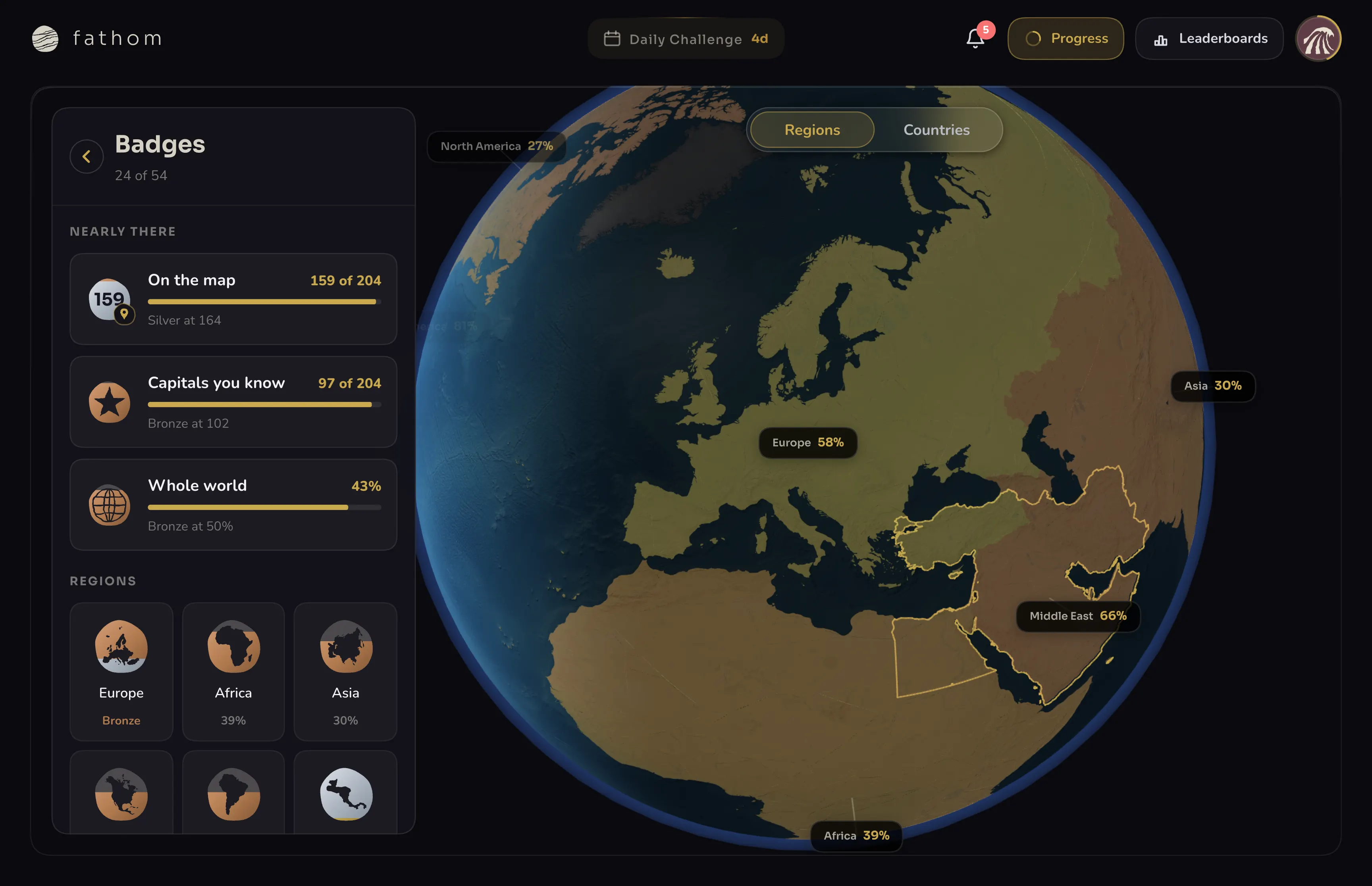
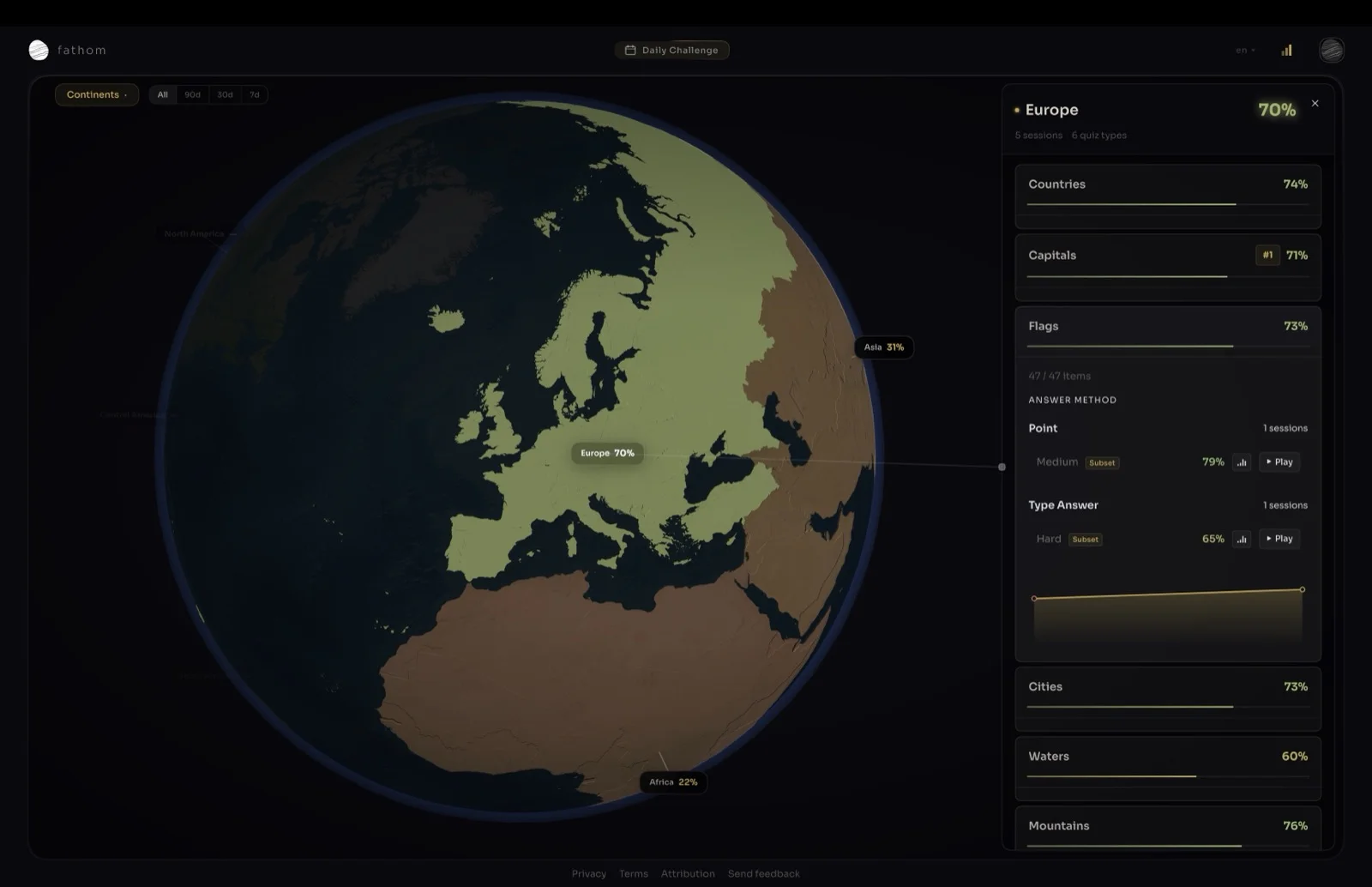
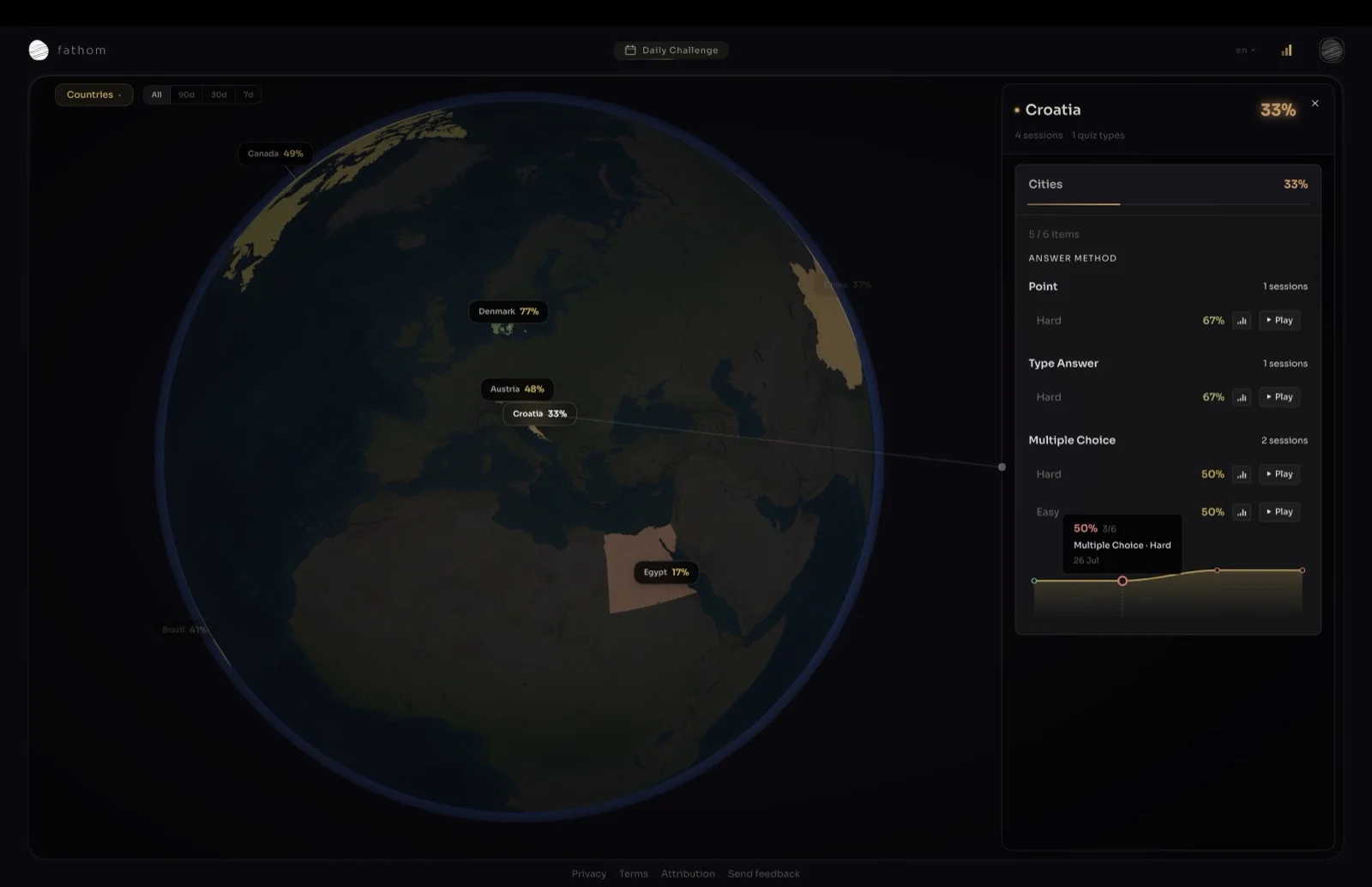
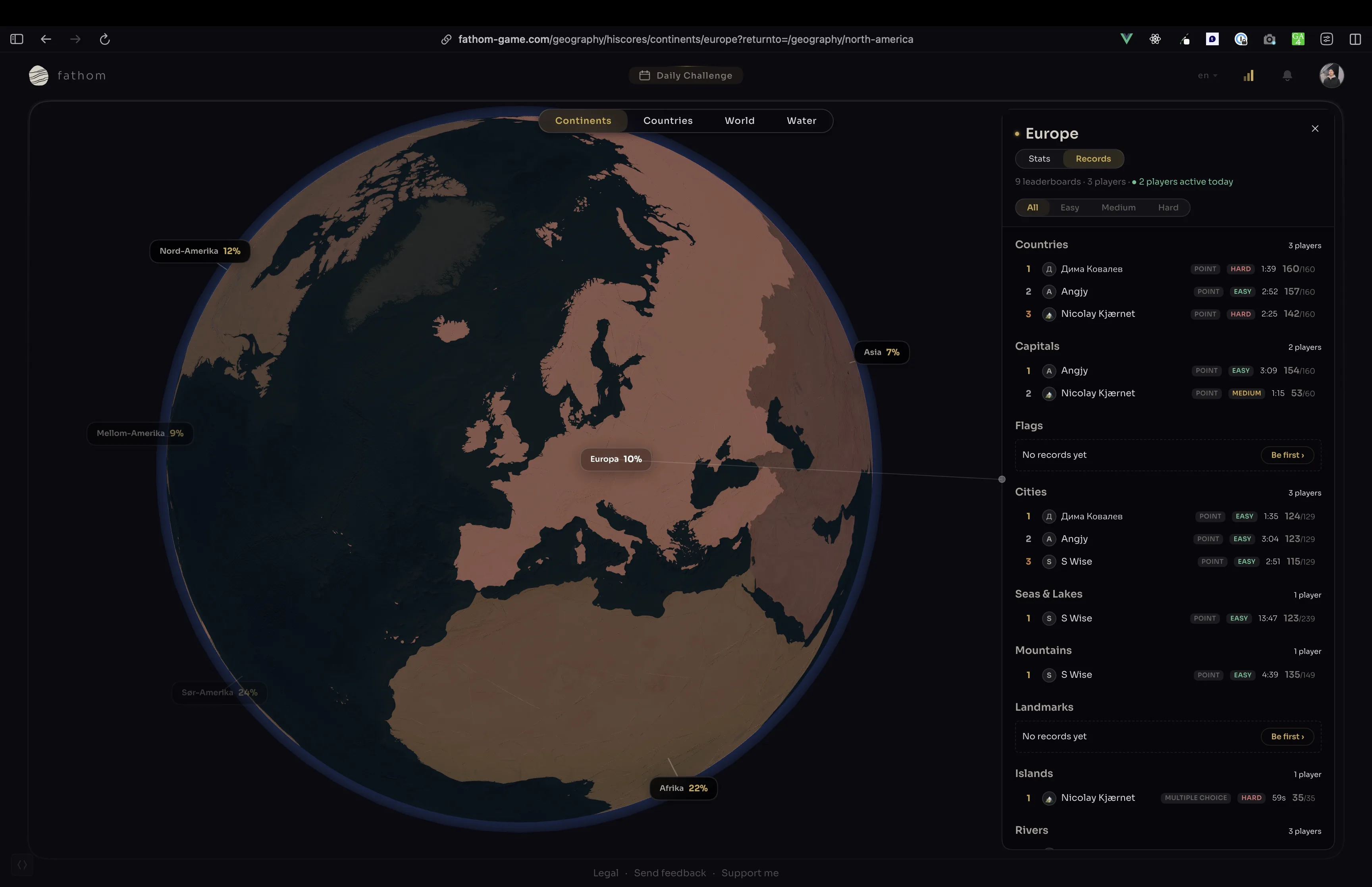
Follow your progress on the globe itself, see your records and statistics, try the daily challenge, and compare scores on the leaderboards if you like.
More about the daily challenge
Come back because you're curious, not because you have to.
What can you learn?
182 quiz packs with more than 6,750 questions about countries, capitals, flags, cities, mountains, rivers, lakes, seas, islands, deserts, volcanoes and famous landmarks. Regional quizzes cover the states, provinces and regions of 164+ countries.
| Category | Content |
|---|---|
 Countries & capitals | 209 countries and their capitals, with regional quizzes for every continent |
 Flags | All 232 country flags shown as detailed SVG images |
 Cities | 1,376 cities across 164+ countries |
 Landmarks | 942 famous landmarks, from ancient ruins to modern icons |
 Waters | 257 bodies of water: oceans, seas, and lakes worldwide |
 Mountains | 240 mountain peaks worldwide |
 Volcanoes | 46 volcanoes across the globe |
 Islands | 158 islands including Greek, Thai, Croatian, Philippine, and Malaysian |
 Deserts | 20 deserts from the Sahara to the Gobi |
 Rivers | 98 rivers across every continent |
 Regions & states | Provinces, states, and regions for 35 countries |
Free, wherever you are
All quizzes and all learning and progress features are free. The website has no ads.
Fathom runs in modern browsers on Windows, macOS, Linux, ChromeOS, iPhone, iPad and Android. You can install it from your browser and play offline. You don't need an account: your progress is saved on your device. A free account syncs it between devices.
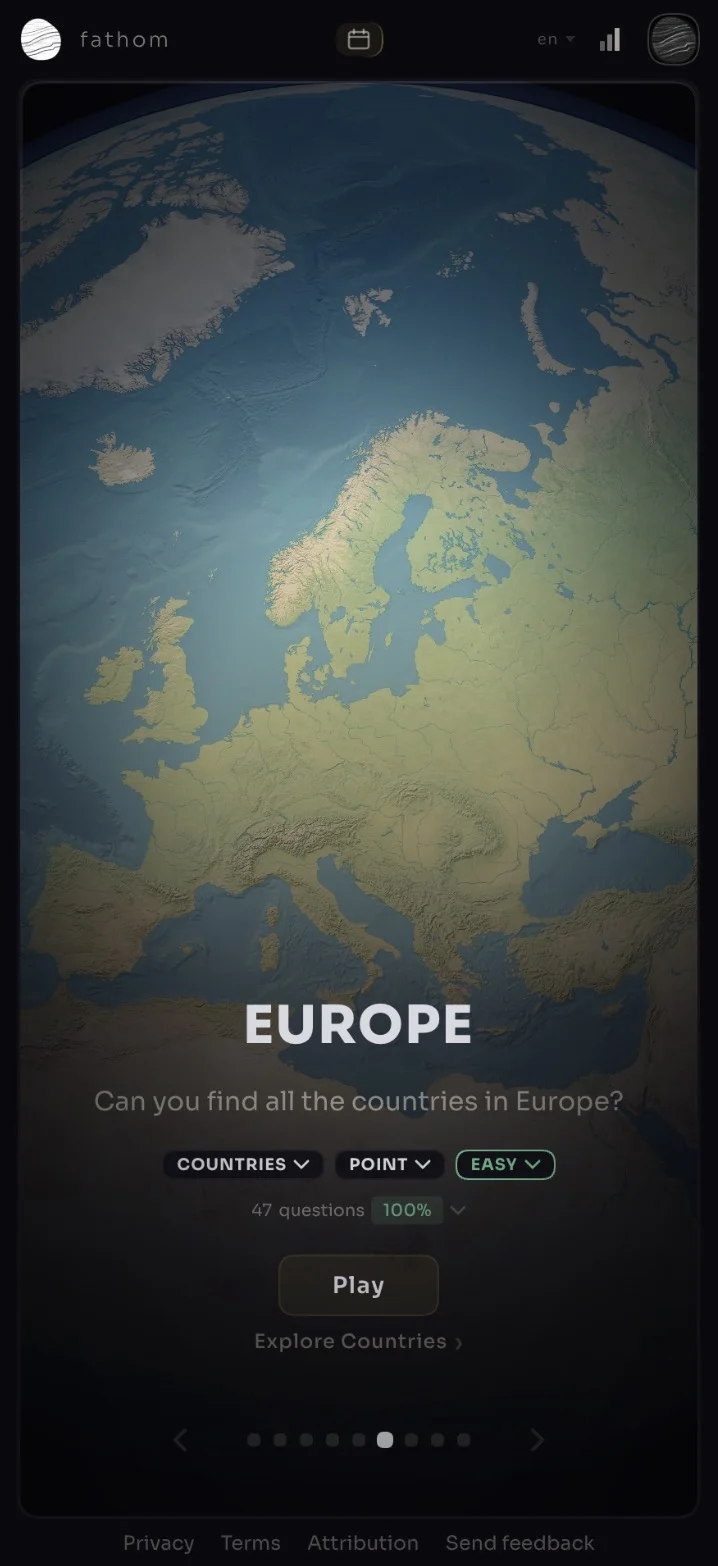
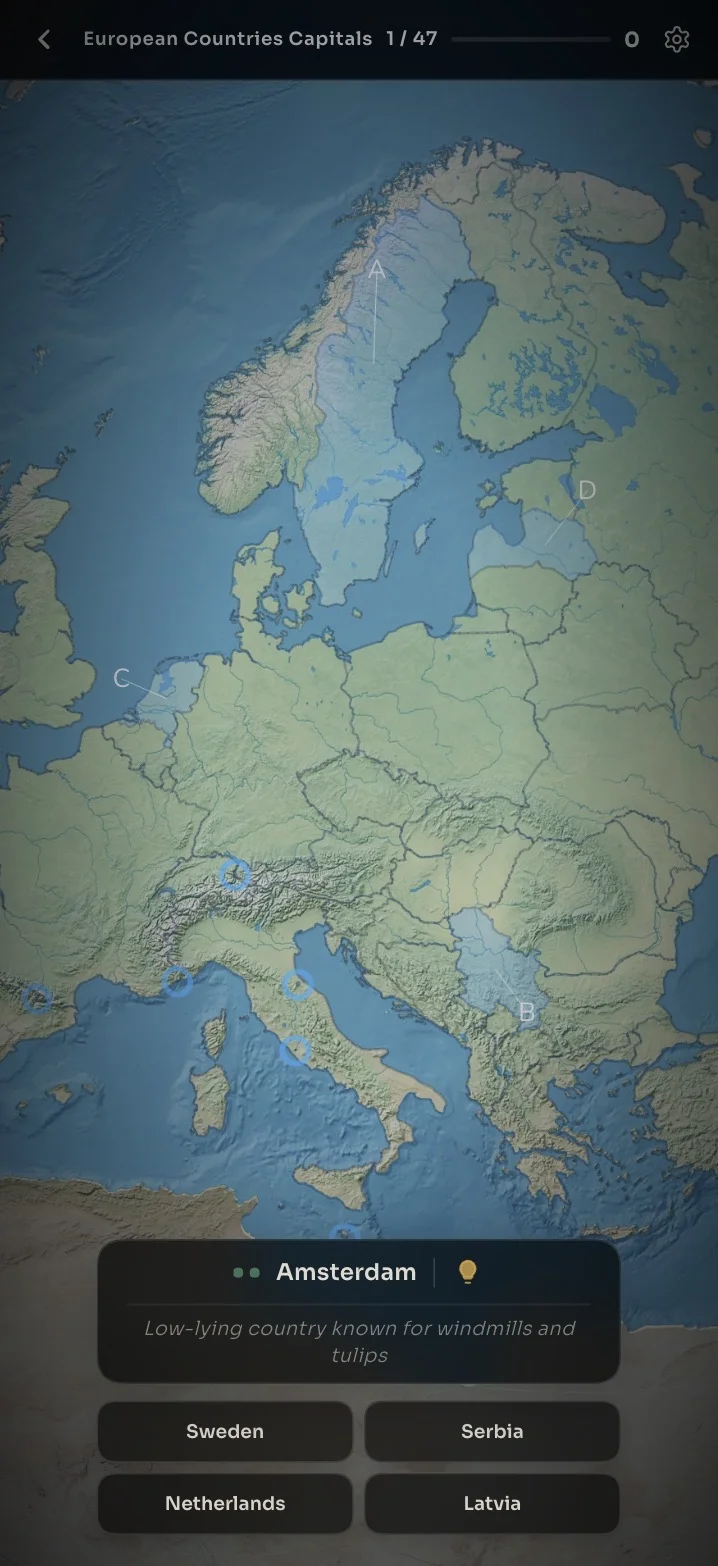
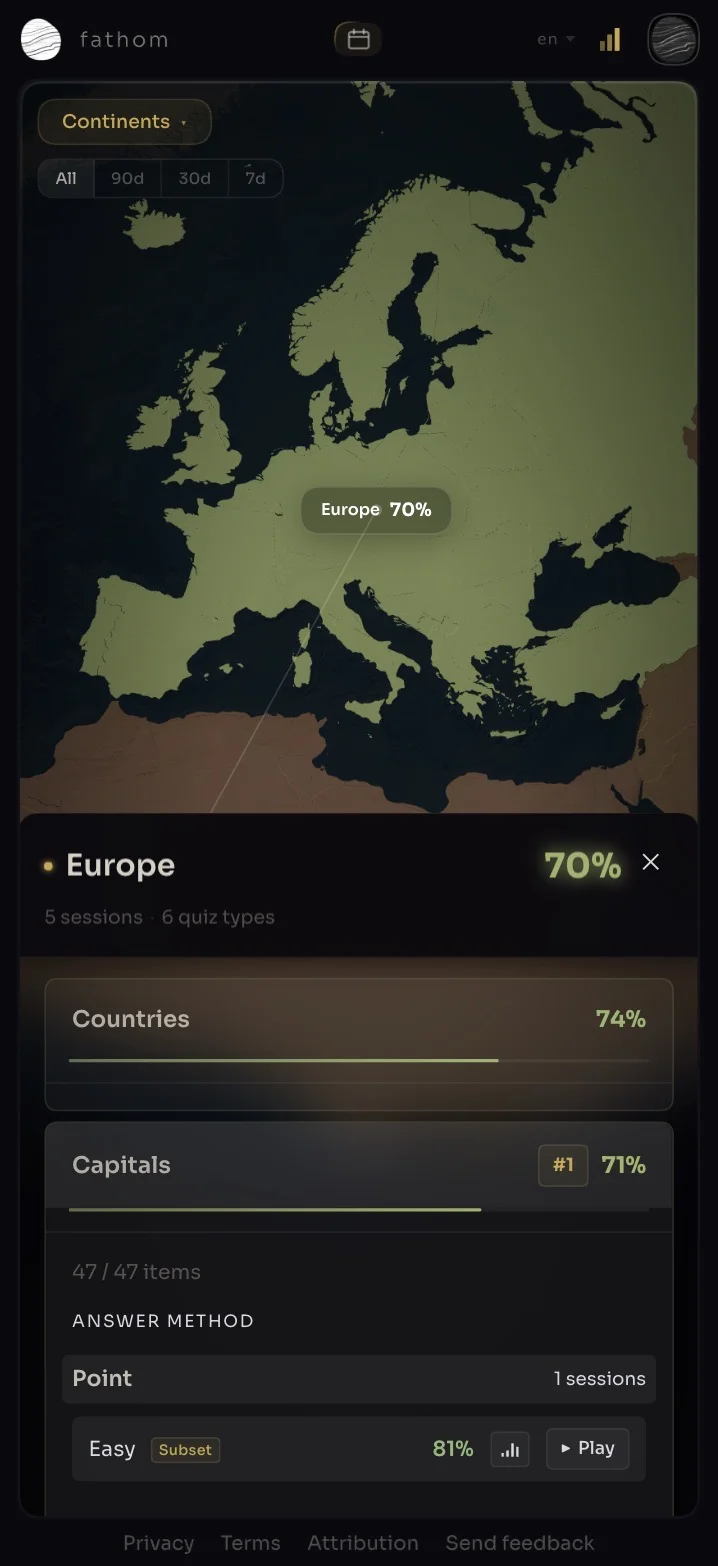
The interface, quizzes and hints are available in 17 languages. The translations are made with the help of AI and then proofread. If you find a mistake, tell us with Send feedback.
Made by an independent developer
Fathom is made by Nicolay Kjærnet, an independent developer in Norway. The globe and the quiz engine are built with Vue and Three.js and run entirely in your browser. Map data comes from Natural Earth and OpenStreetMap. The photos in Learn more come from Wikimedia Commons, with credits on each photo (full attribution).
Curiosity without pressure. Fathom is built on a simple idea: learning about the world should be free, unhurried and driven by curiosity. So much of what we see online is made to be scrolled past and forgotten. Fathom is made for the opposite: to slow down, look closer, and remember.
Frequently asked questions
Is Fathom free?
Yes. Every quiz and every learning and progress feature is free, and you can start without an account. The website has no ads.
How many questions are in a round?
A round has 10 questions by default. You can choose a longer round or play the whole quiz. Smaller quizzes have fewer questions.
Can I take a geography quiz covering a whole continent?
Yes. Choose Mixed at the bottom of any region's quiz list to combine questions from all its quizzes into one round. Play 10 questions, choose a longer round, or try every question in the region. You can also test yourself on the whole world, with 1,106 questions covering countries, capitals, flags, cities, oceans, mountains and more. Your answers count towards your progress, but Mixed rounds don't appear on the leaderboards.
What happens when I get an answer wrong?
In a short round, the question is asked once more at the end. Spaced repetition then brings it back on later days until you know the answer.
Do I need an account?
No. Your progress is saved on your device. A free account syncs it between devices and lets you follow other players. Anything you played before signing in is merged into your account.
What is spaced repetition?
Spaced repetition means reviewing at growing intervals. Fathom brings difficult questions back sooner and familiar ones later, which helps you remember them for longer.
Why is it called Fathom?
To fathom something is to understand it deeply. A fathom is also a sailors' unit of depth, about 1.8 metres (six feet), measured with a weighted line. The stone in the logo is that weight. Its layers form slowly, the way knowledge builds up. As your knowledge grows, the stone sinks deeper.
What is the dive after each round?
The dive shows how deep your knowledge goes. Every step a question climbs in spaced repetition takes the stone closer to the Challenger Deep. After a round in which you make progress, the stone sinks through the ocean's real zones, past the sea life that lives there and finds that earn badges. Forgetting never pulls it back up. The dive also shows the shards the round brought up. Shards buy freezes, which keep your days in a row from breaking.
Can I play on my phone?
Yes. Fathom runs in modern browsers on Windows, macOS, Linux, ChromeOS, iPhone, iPad and Android. You can also install it from the browser and play offline.
Is Fathom coming to the App Store and Google Play?
Yes. Apps for iPhone, iPad and Android are on the way. Until then, you can install Fathom from your browser and play offline, on your phone too.
How is Fathom different from other geography quizzes?
You answer on a 3D globe rather than a flat map. What you miss comes back, at the end of a short round and on later days, until you know it. Every place has a photo and a few lines about it, so a quiz can also teach you something. And your progress is shown as mastery badges and a dive towards the bottom of the ocean.
Does Fathom have a daily challenge?
Yes. Everyone gets the same 10 questions each day, on a fixed weekly plan. You can share your result.